
In contrast to homeopathy and animal derived remedies which will be mentioned in further detail next, which have little or no scientific evidence to support their extraneous practice, herbal remedies have continually gained favor from the scientific community. Many herbal remedies such as the drug Artemisinin, which is derived from the Chinese Sweet wormwood plant, has been used to treat Malaria in China for hundreds of years. On top of that, nearly a quarter of all modern medicines are derived from natural products. As described in a Science and Development article titled “Integrating Modern And Traditional Medicine,” many popular drugs today share a similar purpose and basis as ancient herbal remedies. For example, Opiates stem from unripe poppy seeds which have been used for general pain relief within Arab, Chinese, European, Indian, and even North American traditional medicines. The pharmaceutical drug Cromoglycate, which is used to treat asthma and other severe allergic reactions by stabilizing the release of Histamines, is most commonly derived from a natural defense mechanism in the Mandrake plant. This toxin from the Mandrake’s leaves has been a remedy used by Egyptian and Middle eastern cultures to treat asthma and allergic reactions for hundreds of years.
Author: grantrold1
The Darker Picture Behind Animal Derived Remedies
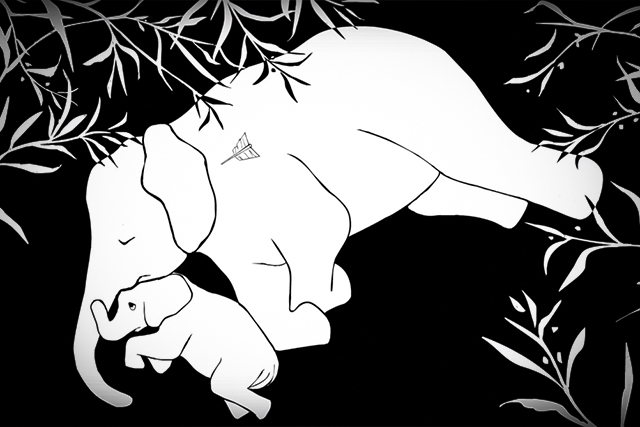
These cartoon Elephants tell a heartbreaking tale of how poaching leaves behind innocent victims such as orphaned baby elephants during the aftermath.
Animals such as the White rhinoceros and African Elephant have been pushed to the brink of extinction as a direct result of illegal hunting. In many Asian countries, the horns of the White Rhino and African Elephant tusks are highly sought after because they are believed to relieve everything from fevers to high blood pressure. However, after thorough scientific research it was concluded that the horns of all five Rhino species are made from Keratin, the same material that makes up Human fingernails. With this discovery in mind, researchers have proven that there is no medicinal value contained in their horns, however after rumors of a high profile individual being treated of terminal liver cancer by medicines containing Rhino horns, poaching of Black and White Rhinos was revamped. Now both species are threatened once again.
Global Policy Regarding Alternative Medicines
Courtesy : (WHO Global Study 2005)
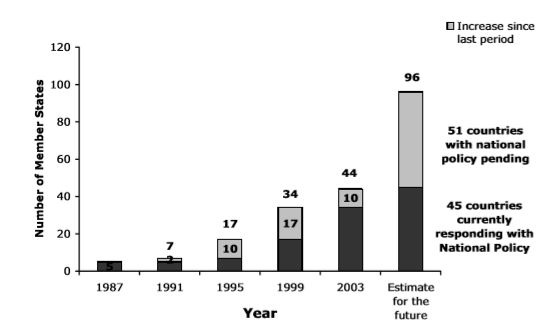
In 2005, The World Health Organization conducted a global study regarding the national policy of different countries on traditional medicine and their different regulations. The above data table which was included in the study shows the increasing number of counties that are responding to the growing world market of alternative medicines. The estimate for the future shows that in 2005, 45 countries have national policies in place to regulate alternative medicines, while another 51 countries have indicated that they have national policies in the process of development. This total of 96 countries is a dramatic increase from the mere 44 in 2003 during the last study. The reasoning behind this upward trend is due to the fast growing nature of alternative medicine worldwide, which grossed $14.3 billion US Dollars in the United States alone during 2016, up from $11.5 Billion US dollars in 2009.
Homeopathy- Fact or Fiction?
In the late 18th century, during a period of dangerous mainstream medical practices such as purging and blood letting, a controversial new field of study was founded. Samuel Hahnemann, the father of homeopathic medicine, closely studied the different medical practices of his time and grew increasingly dissatisfied with their efficacy. Techniques such as blood-letting and purging as previously mentioned, were rooted in the concept of surgically removing the diseased portion of the body from the host, whether from draining portions of blood or removing entire organs from a patient. Though theoretically beneficial, often times this only worsened the patient’s condition and occasionally proving fatal.
As a result of the unfortunately high mortality rates of 18th century medicine, Hahnemann advocated for the use of single drugs at exceptionally low concentrations, based on a preconceived notion that living things differ from inanimate objects because they are governed by different universal laws. counter intuitively, homeopaths believe that compounds gain strength not from being highly concentrated, but instead from being highly diluted in either a one to ten or one to one hundred ratio. The most common notation is ’30x’ for one to ten, and ’30c’ for one to one hundred, with the ’30’ referring to the number of serial dilutions. As a result, an individual would have to drink 90,921 trillion, trillion, gallons of water, 90 trillion times the amount of water on the Earth, in order to encounter one drop of the original diluted compound at 30x. At 30 c, an individual would need to drink 90,921 billion, trillion, trillion, trillion, gallons of water, almost one trillion times the estimated amount of water in our solar system, before encountering one drop of the original homeopathic compound. With all of this in mind, homeopathic medicine is highly ineffective at treating any illness since the most powerful of homeopathic compounds are so highly diluted that they no longer even contain a single particle of the solution. Historically, these treatments gained such popularity as an alternative medicine because the patient’s self recovery was likely confused with the homeopathic treatment, since the ineffective medicine neither helped nor hindered their recovery.
Introduction To Traditional Medicine
Throughout much of Human history, different cultures have relied on herbal remedies and supernatural beliefs in order heal their sick. As our scientific understanding has developed, new and more effective medical techniques have been discovered. However, much of the world today still relies on traditional medicines such as homeopathy and herbal remedies as their primary form of healthcare, despite the disproven effectiveness of many of these practices. The research preformed for the informative essay seeks to provide insight behind this almost paradoxical statistic.
The Journey Begins
Thanks for joining me!
Good company in a journey makes the way seem shorter. — Izaak Walton

 Grant's Blog